pixel art
Images built deliberately pixel by pixel, where every square is a decision — the visual language of early computers and games, now a fine-art tradition of its own.
what it is
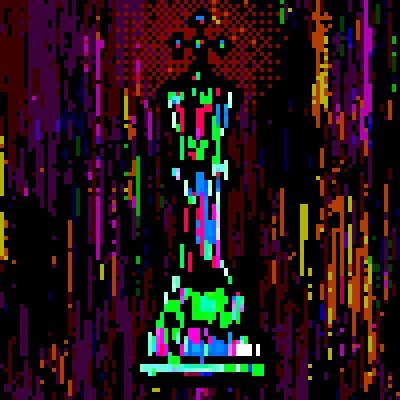
Pixel art is defined by constraint: a small canvas, a limited palette, and placement by hand rather than by filter. Artists use dithering to suggest gradients, and anti-aliasing by hand to soften edges, much as earlier artists worked within the grid of mosaic or cross-stitch.
Character-based forms such as ASCII art and PETSCII — images made only from a computer's built-in text characters — push the constraint even further, and dithering lets a tiny palette suggest far more colours than it has.
a short history
Pixel art emerged with arcade machines and home computers in the 1970s and 1980s, when hardware limits made every pixel count; the phrase itself appears in print in 1982, in work by Adele Goldberg and Robert Flegal at Xerox PARC. The demoscene, game studios and online communities carried it through the 1990s and 2000s.
On-chain, pixel art became foundational: CryptoPunks (2017) are 24×24-pixel portraits, and many early cryptoartists worked at tiny resolutions that suited both the aesthetics and the storage limits of the medium.
further reading
at protocol decay